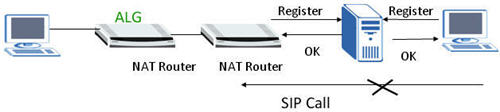
Gateway a livello di applicazione (ALG) per SIP
I router Keenetic dispongono di un gateway a livello di applicazione (ALG) per il protocollo SIP.
L'SIP ALG è un gateway a livello di applicazione che consente al traffico vocale VoIP (RTP) di passare senza ostacoli attraverso un dispositivo con NAT (Network Address Translation). Se SIP ALG è presente e abilitato nel router, non è necessario configurare ulteriormente l'inoltro delle porte per questo tipo di traffico.
Per abilitare l'SIP ALG, installa il componente corrispondente nel router:

Di norma, gli indirizzi IP dei client di telefonia SIP vengono assegnati da un intervallo di indirizzi interni (locali) e i loro indirizzi IP possono sovrapporsi. Nella maggior parte dei casi, gli utenti si connettono alla rete tramite un dispositivo con NAT (tramite un router). Se questo dispositivo non supporta SIP ALG, un server SIP non sarà in grado di distinguere i client.
I client VoIP possono essere registrati su un server SIP utilizzando uno dei seguenti metodi per bypassare il NAT: Outbound proxy, STUN o SIP ALG. Tuttavia, se uno dei primi due metodi è configurato su un telefono VoIP o su un altro dispositivo con un client SIP situato dietro un NAT, SIP ALG deve essere disabilitato sul dispositivo.
Per un passaggio senza ostacoli del traffico SIP attraverso un dispositivo con NAT, è necessario tradurre l'indirizzamento nei pacchetti SIP. Un pacchetto SIP viene esaminato a livello di applicazione e gli indirizzi IP in esso contenuti vengono modificati. Pertanto, SIP ALG consente di implementare i servizi di telefonia SIP in una rete con traduzione degli indirizzi NAT senza utilizzare dispositivi esterni ausiliari.
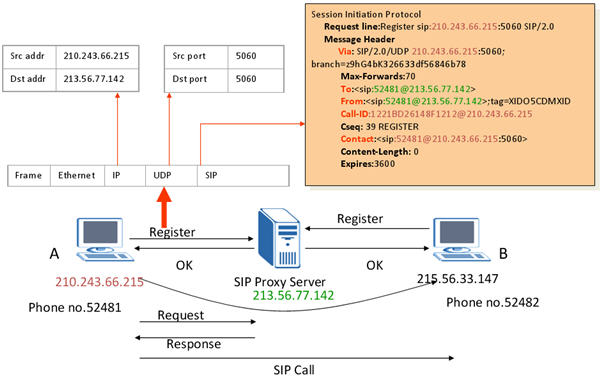
Esempio 1. Non è presente alcun dispositivo con NAT nel percorso dei pacchetti SIP.
Esempio 2. È presente un dispositivo con NAT e supporto SIP ALG nel percorso dei pacchetti SIP.
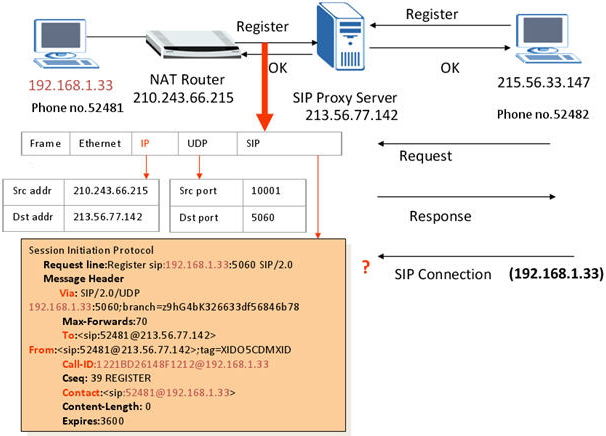
In questo caso, il dispositivo con NAT (router) sostituisce l'indirizzo IP di origine 192.168.1.33 nei pacchetti IP con il proprio indirizzo IP WAN 210.243.66.215.
Importante
Tutti i dispositivi con NAT devono supportare il meccanismo SIP ALG. Se nel percorso dei pacchetti SIP è presente un dispositivo con NAT che non supporta l'SIP ALG, la telefonia SIP non funzionerà.